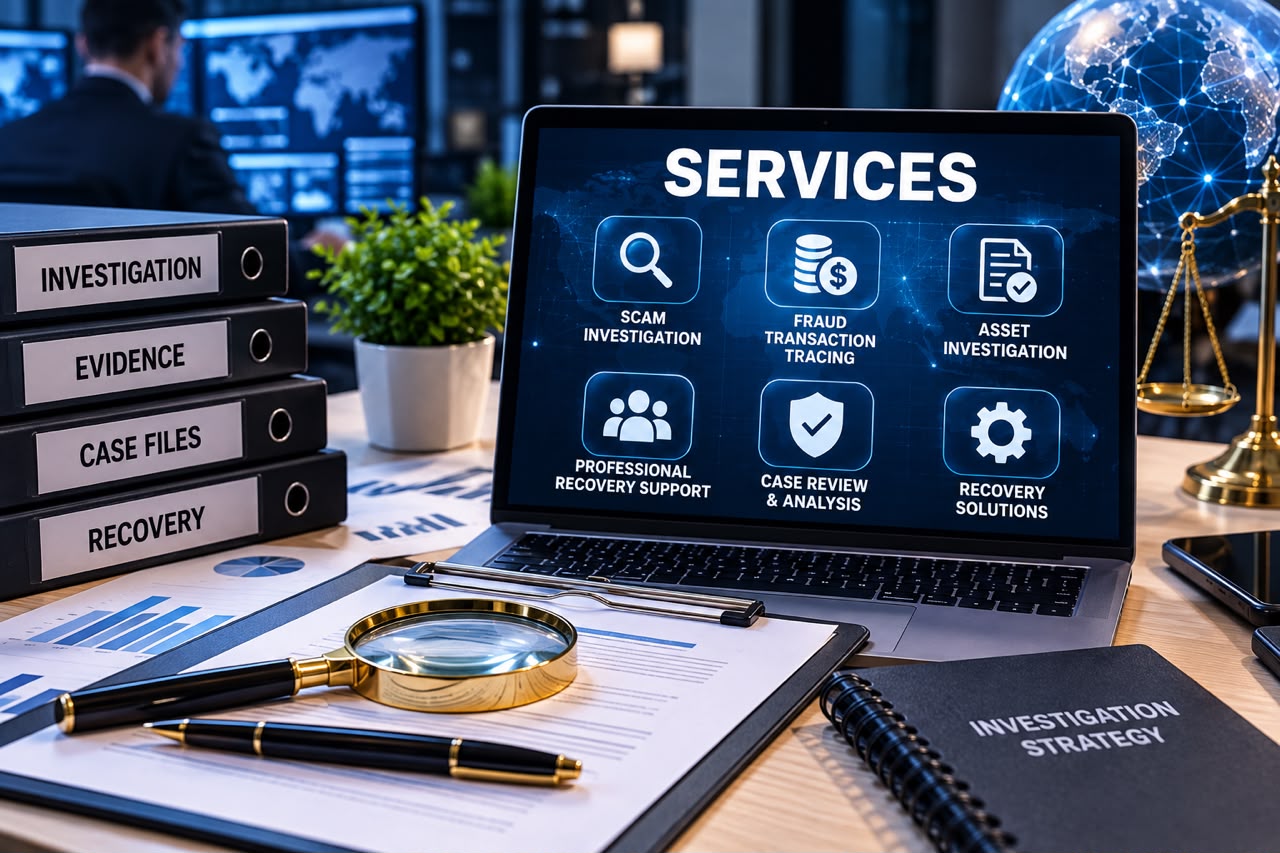
Trace and Recover Funds Lost to Scammers
Scam investigation, fraud transaction tracing, and professional recovery support for victims and organizations.
Our Scam Recovery Services
From first scam report to forensic tracing and evidence packaging, our services are designed to improve recovery outcomes.
Crypto Investment Scams
Tracing support for fake investment platforms, rug pulls, and high-yield crypto scam schemes.
- Wallet flow tracing
- Exchange escalation
Blockchain Forensics
Advanced forensic tracing to follow stolen crypto transactions across wallets and exchanges.
- On-chain mapping
- Case documentation
Romance Scams
Recovery assistance for victims who sent funds to fake online relationships and identity fraud schemes.
- Payment trail analysis
- Evidence bundling
Shipping Container Scams
Investigation support for fake freight, shipping container, and logistics payment fraud incidents.
Pet Scams
Tracing support for fake breeder, pet adoption, and transport-fee scam transactions.
Impersonation Scams
Case support for government, police, bank, and customer-support impersonation fraud.
Employment Scams
Investigation support for fake job offers requiring upfront crypto or wire payments.
Advance Fee and Loan Scams
Tracing for fake loan approvals, tax-release fees, and advance-fee fraud payments.
Ransomware Payment Cases
Specialized services to trace ransom payments, monitor movement, and support recovery escalation.
Recovery Services: A Structured Guide to Fraud, Scam, and Digital Asset Recovery
Recovery Services provide structured support for individuals and organizations dealing with financial losses, suspected fraud, scams, inaccessible digital assets, or complex transaction histories. Depending on the circumstances, recovery-related work may involve evidence review, financial analysis, transaction tracing, digital asset investigation, case documentation, and guidance on appropriate reporting channels.
A responsible recovery process begins with understanding what happened rather than making assumptions about the outcome. The nature of the loss, the available evidence, the payment method, the platforms involved, and the time that has passed can all affect what actions are realistically available.
Recovery work should also be clearly distinguished from guaranteed recovery. An investigation can identify evidence, organize transactions, and support reporting, but no legitimate service can guarantee that every lost asset will be returned.
Asset Recovery Services
Asset Recovery Services can involve examining the circumstances surrounding lost or transferred assets and identifying legitimate options for pursuing the matter.
Depending on the case, this may involve:
Financial transaction review
Cryptocurrency transaction analysis
Evidence organization
Account activity review
Digital asset investigation
Documentation support
Reporting guidance
Coordination with relevant financial or online platforms
The appropriate service depends on the type of asset and how the loss occurred.
Fraud Recovery ServicesFraud Recovery Services focus on cases where an individual or organization believes money or assets were obtained through deceptive or unauthorized activity.
A structured fraud recovery assessment may review:
Payment records
Bank statements
Invoices
Contracts
Emails
Messages
Account information
Website information
Transaction records
The objective is to establish a clear factual record and determine which
legitimate recovery or reporting channels may be available.
Scam Recovery Services
Scam Recovery Services may assist with documenting and analyzing suspected scams involving online platforms, investments, marketplaces, social media, cryptocurrency, or other digital channels.
A scam case can be organized around a timeline:
Initial contact → representation or offer → request for payment → transaction → subsequent communications → discovery of suspected fraud → reporting
This structure makes it easier to connect communications and financial activity.
It is important to remain cautious when selecting recovery assistance. People who have already lost money can become targets for secondary recovery scams. Claims of guaranteed recovery should therefore be treated with particular caution.
Financial Recovery Services
Financial Recovery Services can involve reviewing transactions and supporting documents associated with a reported financial loss.
A financial case review may examine:
Transaction dates
Amounts
Currency
Payment methods
Recipient information
Transaction references
Bank records
Payment-platform records
Related communications
The review can help establish how funds moved and which records support the reported circumstances.
Recovery Investigation Services
Recovery Investigation Services provide structured investigation and evidence analysis for cases involving suspected financial or digital asset losses.
A typical investigation can include:
Case intake
Scope definition
Evidence identification
Evidence preservation
Timeline development
Transaction analysis
Digital evidence review
Findings documentation
Appropriate reporting guidance
The investigation should distinguish between verified facts, unverified claims, and unresolved questions.
Fraud Investigation Services
Fraud Investigation Services focus on examining evidence associated with suspected fraudulent activity.
A professional review may compare statements with financial records, communications, documents, and account information.
For example, if a payment was made following a particular representation, the investigator can compare the communication surrounding that representation with the payment record and supporting documents.
This evidence-based approach helps avoid reaching conclusions that are not supported by available records.
Scam Investigation Services
Scam Investigation Services examine the circumstances surrounding suspected deceptive activity.
Depending on the case, investigators may review:
Websites
Domain information
Social-media profiles
Email addresses
Usernames
Messages
Advertisements
Payment instructions
Financial records
Cryptocurrency transactions
Online information should be independently evaluated because digital profiles and websites can contain misleading or false information.
Transaction Tracing Services
Transaction Tracing Services focus on reconstructing the movement of funds or digital assets through available transaction records.
For conventional financial transactions, relevant records may include bank statements, transfer confirmations, payment-platform records, and transaction references.
For cryptocurrency, transaction tracing may involve:
Blockchain networks
Wallet addresses
Transaction hashes
Token transfers
Timestamps
Exchange-related information
Transaction tracing can document the movement of assets, but tracing does not automatically identify the real-world person controlling an address or guarantee that assets can be recovered.
Asset Investigation Services
Asset Investigation Services involve examining information related to an asset and the circumstances surrounding its movement or loss.
For digital assets, this may include blockchain transaction analysis. For conventional financial assets, it may involve bank records, payment information, contracts, and other documentation.
The scope should be clearly defined before work begins so that the client understands what information will be reviewed and what the investigation is intended to establish.
Professional Recovery Services
Professional Recovery Services should emphasize transparency, evidence, and realistic expectations.
Before engaging a provider, consider asking:
What exactly will be investigated?
What information will be reviewed?
How will fees be calculated?
What are the limitations of the service?
What documentation will be provided?
What information does the provider require?
How will confidential information be protected?
A professional service should be able to explain its methodology without making unrealistic promises.
Recovery Assistance
Recovery Assistance can include practical support with organizing evidence, understanding transaction records, documenting a case, and identifying appropriate institutions or platforms to contact.
Useful assistance may involve creating:
A case timeline
Transaction summaries
Evidence inventories
Communication records
Supporting-document collections
Investigation reports
Recovery assistance should not require unnecessary access to sensitive credentials.
Financial Fraud Investigation
A Financial Fraud Investigation examines the financial activity surrounding a suspected fraudulent event.
The investigation can compare transaction records against communications, contracts, invoices, account statements, and other evidence.
A simple transaction table can help organize the case:
| Date | Amount | Method | Recipient | Reference | Evidence |
|---|---|---|---|---|---|
| Date | Amount | Bank/Card/Crypto | Recipient | Transaction ID | Receipt |
| Date | Amount | Bank/Card/Crypto | Recipient | Transaction ID | Statement |
This creates a chronological financial record that can be reviewed alongside the broader case timeline.
Digital Asset Recovery
Digital Asset Recovery may involve cryptocurrency wallets, blockchain transactions, exchange accounts, or other digital assets.
An important distinction is whether the problem involves access to an asset or a transfer of an asset.
For example, someone who cannot access a wallet but still has a valid recovery method may have a technical wallet-access problem. Someone who transferred cryptocurrency to another address may instead require transaction documentation and investigation.
These situations should not be treated as identical.
Lost Asset Recovery
Lost Asset Recovery can refer to assets that are inaccessible, misplaced, transferred without authorization, or lost through suspected fraud.
The available options depend on the circumstances.
Important questions include:
What asset was lost?
When was it lost?
How did the loss occur?
Which platform was involved?
What records remain?
Was the asset transferred?
Is a recovery credential available?
Has the incident been reported?
A detailed assessment can help determine which type of professional or institutional assistance may be appropriate.
Recovery Case Investigation
A Recovery Case Investigation brings the available evidence together into an organized case file.
A comprehensive case file can include:
Case summary
Timeline
Parties and accounts
Financial transactions
Digital evidence
Communications
Supporting documents
Investigation findings
Reporting history
Outstanding questions
The investigation should clearly distinguish evidence from assumptions.
For cryptocurrency cases, blockchain records can be useful for documenting transactions, but a wallet address alone does not necessarily establish the identity of its controller. Similarly, identifying a transaction does not automatically mean that the transaction can be reversed.
Building a Responsible Recovery Services Framework
Effective Recovery Services should be based on a clear process: assess the case, preserve evidence, investigate the available records, analyze transactions, document findings, and identify appropriate next steps.
The quality of the evidence is often more important than the amount of information collected. Original communications, transaction records, account information, blockchain data, contracts, receipts, and other supporting documents should be organized carefully.
People seeking recovery assistance should also protect sensitive credentials. Never provide a seed phrase, private key, password, PIN, or authentication code to an unsolicited recovery provider.
Most importantly, legitimate recovery work should not depend on guaranteed-outcome promises. Some cases may have viable reporting or recovery options, while others may face technical, financial, or legal limitations. A responsible service explains those limitations clearly and focuses on evidence-based assistance.
A structured approach gives clients a clearer understanding of their case and helps ensure that available information is preserved, analyzed, and presented through appropriate channels.