Recover Your Stolen Funds
Specialist support for cryptocurrency scams, romance fraud, investment schemes, and other financial crimes.
Global Fund Recovery Impact
Types of Scams We Help Recover From
Crypto and Investment Scams
Fake trading platforms, wallet theft, and Ponzi-style schemes.
Romance Scams
Online relationships used to manipulate victims into sending funds.
Financial Scams
Fake loans, credit repair schemes, and fraudulent financial services.
Impersonation Scams
Government, bank, and support impersonation fraud.
How We Recover Your Funds
Initial Assessment
We analyze case details, transaction records, and evidence.
Blockchain Investigation
Our team traces transactions across chains and exchanges.
Evidence Compilation
We prepare forensic reports and evidence packages.
Recovery Action
We support escalation paths with banks, exchanges, and reporting bodies.
Recently Scammed? Act Fast.
Time is critical in fund recovery. Submit your case details through the secure form and preserve evidence immediately.
File Emergency ReportScam Report Review: A Practical Guide to Reviewing and Documenting Scam Cases
How to Review a Scam Report
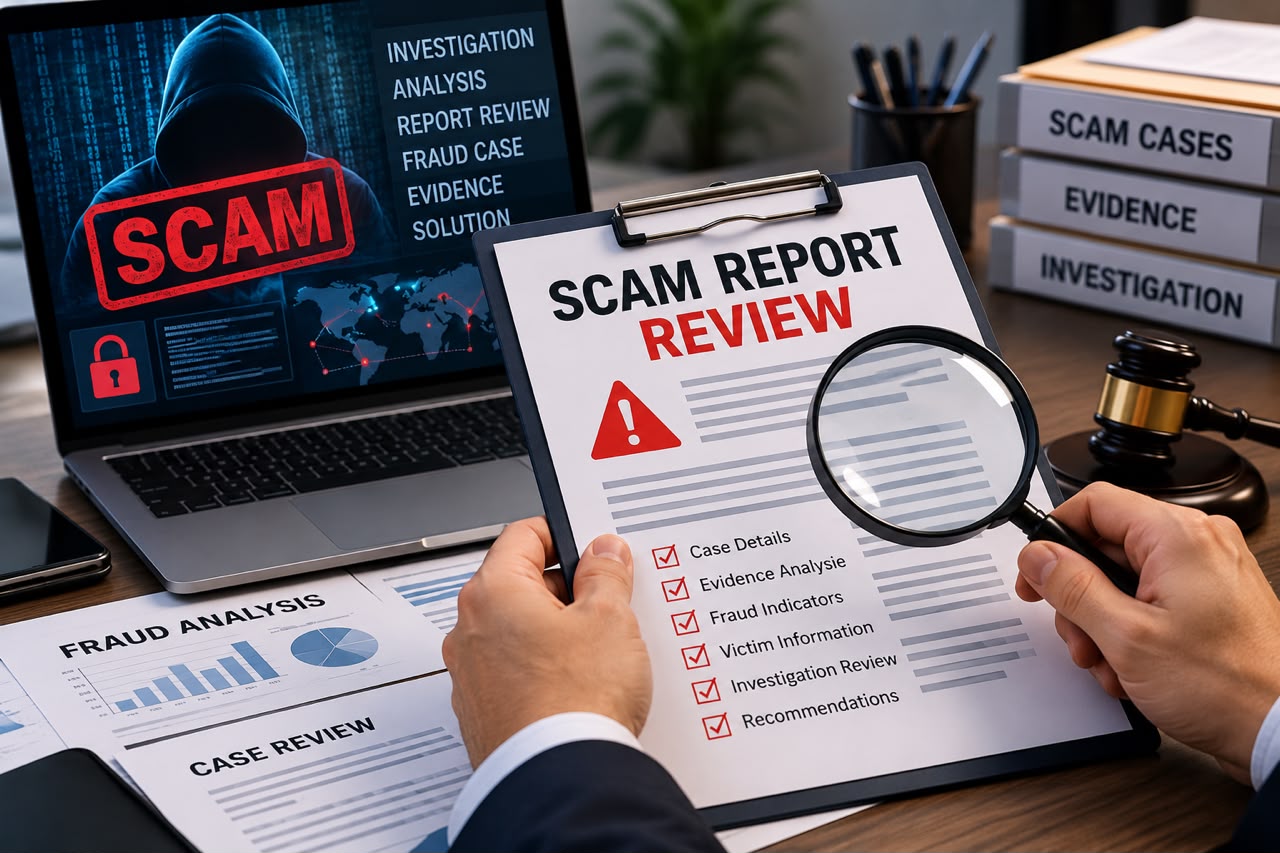
A Scam Report Review is a structured process for examining the facts, evidence, communications, transactions, and circumstances surrounding a suspected scam. A well-prepared review can help organize complicated information, identify important details, and determine which reporting or support channels may be appropriate.
Whether the case involves cryptocurrency, online payments, investments, marketplaces, social media, or identity fraud, the quality of the documentation matters. A clear report should separate verified facts from assumptions and preserve original evidence wherever possible.
How to Analyze a Scam Case
A useful scam case analysis begins by establishing a timeline. Record when contact started, how the communication developed, what was requested, what payments or transfers occurred, and when concerns about fraud first appeared.
Look for details such as:
Names, usernames, email addresses, phone numbers, or website addresses used by the suspected scammer
Dates and times of important communications
Payment amounts and transaction dates
Bank, card, payment-platform, or cryptocurrency transaction information
Screenshots and copies of relevant messages
Invoices, receipts, contracts, or other documents
Website addresses and social-media profiles
Statements made about products, investments, services, employment, or financial returns
Any warnings, requests for additional payments, or changes in the story
A strong Digital Fraud Case Review does not assume that every unusual event proves fraud. Instead, it organizes the evidence and identifies inconsistencies that may require further investigation.
How to Report an Online Scam
Once the available information has been organized, the next step is identifying the appropriate reporting channel. Depending on where the victim is located and what type of scam occurred, this may include a bank or payment provider, cryptocurrency exchange, marketplace, social-media platform, local law enforcement, consumer-protection agency, or another relevant authority.
When reporting an online scam, provide factual information in chronological order. Avoid exaggerating losses or making accusations that cannot be supported by evidence.
A useful report can include:
A brief case summary — Explain what happened in a few clear sentences.
Timeline of events — List important events in chronological order.
People or accounts involved — Record available identifying information.
Financial information — Document payments, transfers, dates, and amounts.
Communication evidence — Preserve relevant emails, messages, and conversations.
Website and account information — Include URLs, usernames, domains, and account details.
Supporting documents — Attach receipts, invoices, screenshots, and other relevant records.
Actions already taken — Explain whether a bank, exchange, platform, or authority has already been contacted.
What to Include in a Scam Report
A comprehensive scam report should answer five basic questions: Who was involved? What happened? When did it happen? How did money or information move? What evidence supports the account?
Start with the basic facts. Include the date the contact began, the method of communication, the service or opportunity that was presented, and what the other party requested.
For financial cases, document each transaction individually instead of providing only a total loss. This creates a clearer record and makes it easier to compare payments with the timeline of communications.
If cryptocurrency was involved, preserve transaction hashes, wallet addresses, network information, exchange records, and screenshots. Do not publish or share private keys or seed phrases as evidence. Those credentials can provide access to a wallet and should remain confidential.
How to Document a Scam
Good documentation can make a complicated case significantly easier to understand.
Save original emails rather than relying only on screenshots. Preserve complete conversations where possible, including dates and account identifiers. Take screenshots when information may disappear, but keep the original files as well.
Create a simple evidence folder containing:
Communication records
Payment records
Transaction confirmations
Screenshots
Website information
Account details
Documents and invoices
Relevant photographs or files
A chronological case summary
Give files descriptive names such as 2026-09-18-payment-receipt.pdf or 2026-09-20-message-screenshot.png. This makes the evidence easier to organize.
Do not edit original evidence unnecessarily. If you need to highlight information, create a separate working copy and keep the original intact.
Online Scam Evidence Review
Online Scam Evidence Review involves examining available records to determine what information they establish and what questions remain unanswered.
For example, a payment receipt may establish that money was transferred, while a conversation may establish what was promised before the payment. Looking at both together can provide more useful context than reviewing either document independently.
Evidence can be grouped into several categories:
Communication evidence: emails, text messages, social-media conversations, and chat records.
Financial evidence: bank statements, card records, payment confirmations, invoices, and transfer receipts.
Digital evidence: URLs, domain information, account usernames, transaction identifiers, and publicly available website information.
Documentary evidence: contracts, investment statements, purchase agreements, employment documents, and other files.
The objective is to create a factual record rather than simply collect a large quantity of screenshots.
Financial Scam Case Review
A Financial Scam Case Review focuses on how money was requested, transferred, received, and potentially redirected.
Create a transaction table containing the date, amount, currency, payment method, recipient information, transaction reference, and supporting evidence.
For example:
| Date | Amount | Method | Recipient | Reference |
|---|---|---|---|---|
| Sept. 5 | $500 | Bank transfer | Account/recipient | Reference ID |
| Sept. 8 | $1,000 | Card payment | Merchant | Transaction ID |
| Sept. 12 | $750 | Crypto transfer | Wallet address | TX hash |
This type of organization can reveal whether multiple transactions relate to the same incident.
If a financial institution or payment provider is involved, contact it promptly and ask what dispute, fraud-reporting, recall, or account-security procedures are available. The available options depend on the payment method and circumstances.
Cryptocurrency Scam Report Review
A Cryptocurrency Scam Report Review requires careful attention to blockchain transactions and wallet information.
Useful records may include:
Cryptocurrency type
Blockchain network
Sending wallet address
Receiving wallet address
Transaction hash
Transaction date and time
Amount transferred
Exchange or wallet platform involved
Relevant communication records
A blockchain transaction can provide valuable technical evidence, but blockchain data by itself does not necessarily establish the real-world identity of a wallet owner.
Crypto Fraud Report Analysis
Crypto Fraud Report Analysis should connect blockchain records with the surrounding evidence.
For example, a transaction hash can establish that a particular transfer occurred. A conversation may establish why the victim made that transfer. An exchange record may provide additional information about the account through which funds moved.
These sources should be compared carefully rather than treating a blockchain address as automatically belonging to a particular person.
Never provide a supposed recovery service with your seed phrase, private key, password, or authentication codes. A person claiming they can recover cryptocurrency should not need unrestricted control of your wallet to “prove” their ability.
Online Payment Scam Review
An Online Payment Scam Review focuses on transactions made through payment platforms, cards, bank transfers, mobile-payment services, or other digital payment methods.
Record:
Payment date
Amount
Currency
Payment provider
Recipient information
Transaction reference
Invoice or order information
Communication surrounding the payment
If the payment was recent, contacting the relevant financial institution or payment provider quickly may be important because available procedures can depend on timing and payment method.
Investment Scam Report Review
An Investment Scam Report Review examines claims made about an investment and compares those claims with the actual transactions and communications.
Important evidence may include:
Investment advertisements
Website information
Promised returns
Account statements
Deposit records
Withdrawal requests
Requests for additional fees
Communications with representatives
Names of companies or platforms used
Cryptocurrency wallet information where applicable
Be especially careful with claims that additional payments are required before supposedly releasing previously deposited funds. Such demands should be documented and independently evaluated before sending more money.
Marketplace Scam Report Review
A Marketplace Scam Report Review concerns transactions involving online marketplaces, classified websites, or peer-to-peer sales platforms.
Preserve the original listing, seller profile, product description, messages, payment records, shipping information, and photographs.
If the seller’s account or listing disappears, screenshots and previously saved records may become particularly useful.
Report the activity through the marketplace’s official reporting process and retain the resulting case or reference number.
Social Media Scam Report Review
A Social Media Scam Report Review examines fraudulent activity conducted through social platforms.
Relevant information can include:
Profile URL
Username
Display name
Messages
Posts or advertisements
Payment requests
Cryptocurrency addresses
Email addresses
Phone numbers
Dates of communication
Do not rely solely on a profile name when identifying an account. Usernames, profile URLs, message records, and other technical details can provide more precise documentation.
Identity Fraud Report Review
An Identity Fraud Report Review focuses on situations where personal information may have been misused.
Potentially relevant evidence includes:
Unauthorized account activity
Unexpected applications or purchases
Suspicious emails
Account-login notifications
Password-reset messages
Unknown financial transactions
Documents showing unauthorized activity
If identity information may have been compromised, secure affected accounts immediately by changing passwords, enabling multi-factor authentication where available, and contacting the relevant financial institutions or service providers.
Building a Clear Scam Case File
A professional Scam Report Review should ultimately produce a clear case file rather than a collection of disconnected evidence.
Start with a one-page summary explaining the suspected scam. Follow it with a chronological timeline, financial transaction records, communication evidence, digital evidence, and supporting documents.
A useful structure is:
Case Summary → Timeline → Parties/Accounts → Financial Records → Digital Evidence → Communications → Supporting Documents → Reporting Actions
This structure makes it easier for a bank, platform, investigator, attorney, consumer-protection organization, or law-enforcement agency to understand the situation.
It is also important to distinguish between evidence, observations, and conclusions. For example, instead of writing “this wallet belongs to the scammer,” a factual report could state, “the payment was sent to this wallet address after the individual provided it during the conversation.” The second statement accurately describes what the available evidence establishes without claiming more than it proves.
Protecting Evidence and Avoiding Recovery Scams
People who have already lost money can become targets for additional fraud. Individuals may claim to be investigators, hackers, blockchain specialists, government representatives, or recovery experts and promise guaranteed recovery in exchange for an upfront fee.
Treat guaranteed recovery claims with caution.
Never provide a seed phrase, private key, password, one-time authentication code, or complete account credentials to someone claiming to investigate or recover your assets.
A legitimate review should focus on evidence preservation, factual analysis, appropriate reporting, and realistic next steps. No legitimate review can guarantee that lost funds will be recovered.
A well-prepared Scam Report Review gives the case a clear structure and helps ensure that important information is not overlooked. Whether the incident involves financial fraud, cryptocurrency, an online marketplace, social media, an investment opportunity, or identity misuse, organized evidence provides a stronger foundation for communicating with the appropriate institutions and reporting channels.